How to Spot a Fake Phone Charger in Bangladesh: 9 Checks Before You Plug In
A counterfeit charger can under-deliver power, overheat and shorten your phone battery life. These nine checks separate a genuine fast charger from a convincing copy, using only things you can see and test at the shop.
Article Content
A phone charger is the one accessory that touches mains power and your battery at the same time, which makes a counterfeit one a bigger risk than a cheap case. Copies look convincing from a metre away, but the details that matter are visible up close and testable in a few minutes.
These nine checks work in a shop, at a market stall or with a charger you already own. None of them require special tools beyond an optional USB power meter, and none of them rely on the packaging alone.
1. Treat the price as the first alarm
Genuine fast chargers carry real component costs: transformers, capacitors, thermal design and safety circuitry. If a 45W or 65W charger is selling for a fraction of the official price, something inside has been removed. A small discount can be legitimate clearance stock; a very large one is usually a copy.
2. Read the printed ratings
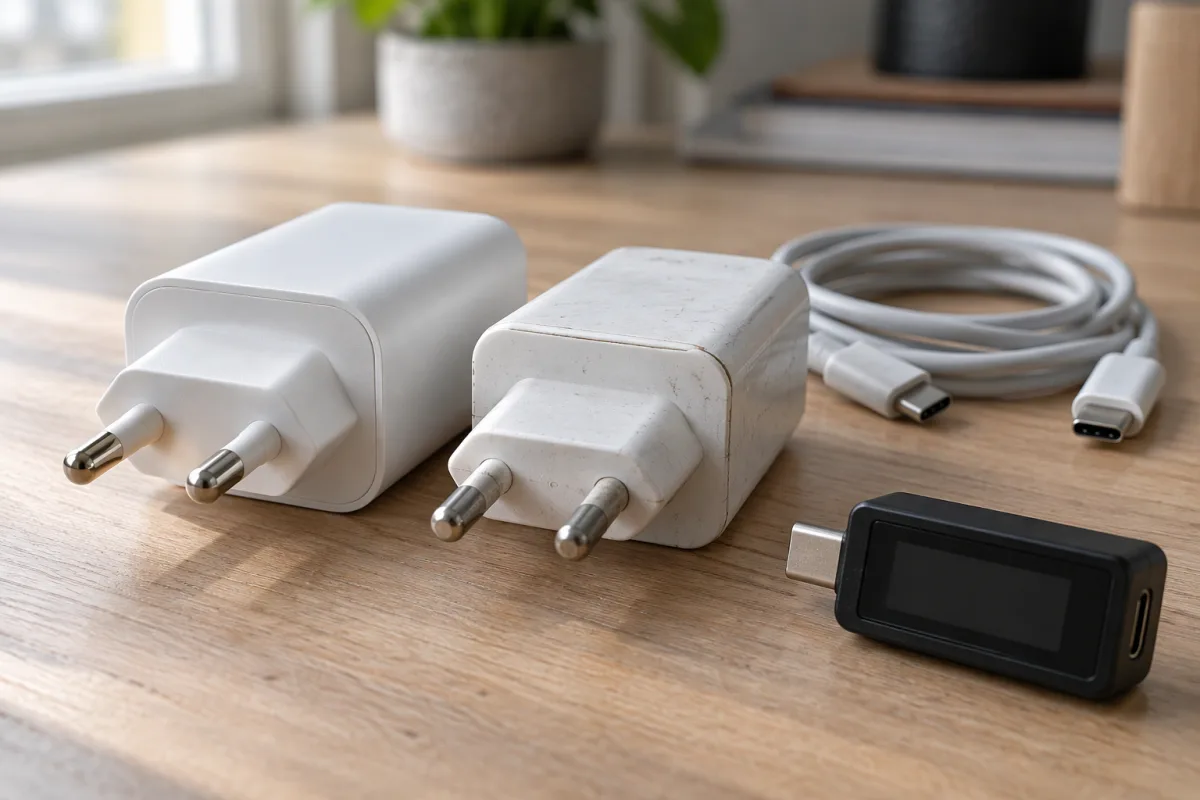
A real charger prints its manufacturer, model number, input voltage and output ratings clearly. The printing is sharp, does not rub off with a thumb, and the numbers are consistent: a 45W charger should show an output combination that adds up to 45W, such as 15V at 3A. Fakes often print vague text, miss the manufacturer name entirely, or list output figures that do not match the claimed wattage.
3. Check the pins and the plug body
The metal pins should sit straight and firm in the body, with no wobble when you press them. The plastic around them should be smooth and evenly moulded, without sharp seams, gaps or excess flashing. A plug that rattles or looks assembled from two poorly matched halves is a copy.
4. Weigh it in your hand
Fast chargers contain more copper and larger capacitors than slow ones, and that shows up as weight. Compare a suspect unit with a known genuine charger of the same wattage if you can. A unit that feels noticeably light and hollow is a warning sign, though weight alone is not proof.
5. Look at the cable connector and strain relief
The connector should fit your phone with a firm click, not a loose wiggle. The strain relief where the cable meets the plug should be flexible but thick, with no visible gap. Copies often fail here first, and a loose connector can damage the charging port on the phone itself.
6. Match the charger to your phone's standard
A charger only delivers its full speed if it speaks the same fast-charging protocol as your phone. USB Power Delivery and PPS cover many Android devices, but some brands use proprietary systems. A 45W charger that does not support your phone's protocol may charge it slowly, and a copy claiming 65W often settles far below that in practice. Check the phone's advertised charging wattage first, then buy a charger rated for that standard.
7. Do the ten-minute heat test
Plug the charger in with your phone at a low battery and leave it for ten minutes. Warm is normal. Too hot to hold comfortably, a buzzing sound or a burning smell are reasons to stop immediately. Genuine chargers are designed to shed heat; copies often are not.
8. Measure the output with a USB power meter
A basic USB power meter costs less than most chargers and shows voltage, current and wattage in real time. It answers the only question that matters: does the charger actually deliver close to its claimed output with your phone? If a 45W unit never climbs far above 15W on a phone that supports 45W, the label is decoration. Test with the cable you plan to use, because a thin or damaged cable can cap power on its own.
9. Buy from a channel that can honour a warranty
Authorised shops, brand showrooms and established online stores provide a receipt and a warranty. A market stall selling unboxed chargers with no paperwork has no path to replace a failed unit. Keep the receipt: it is also the only way to prove where the charger came from if it damages a phone.
If you already own a suspect charger
- Stop using it if the body is swollen, cracked, discoloured or smells of burning.
- Replace damaged cables first; many charging problems are cable problems, not charger problems.
- Do not charge on a bed, sofa or pillow, where heat cannot escape.
- Avoid daisy-chaining extension cords for a fast charger, and unplug it when not in use.
- If your phone charges slowly or gets unusually hot with one charger, test another known-good unit before blaming the phone.
What this looks like in practice
Phones such as the Helio 150 and the Redmi 17 5G advertise 45W charging, and that is the number to match when buying a replacement. Paying for the right wattage and the right protocol is worth more than paying for a bigger number on the box.
A charger is not the place to save the last few hundred taka. The nine checks above take a few minutes, and they are the difference between a charger that quietly does its job and one that quietly damages the phone it is supposed to serve.