Top 5 Flagships of 2026: Who Leads in AI, Camera and Performance?
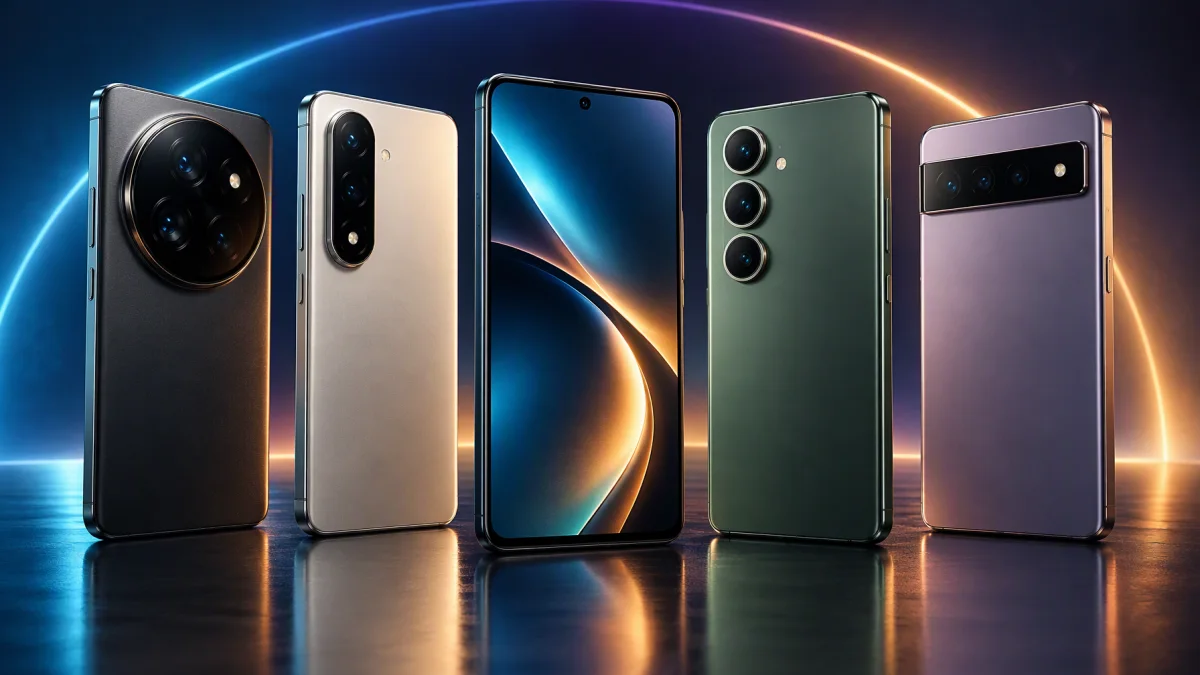
We compared the five phones defining the 2026 flagship class — iPhone 18 Pro Max, Galaxy S26 Ultra, Pixel 11 Pro XL, Xiaomi 17 Ultra and vivo X500 Pro Max — across AI features, camera hardware and raw performance.
Article Content
Flagship phones in 2026 are no longer separated by a single killer feature. AI has moved from demo reels into everyday shooting and editing tools, camera hardware has converged on large sensors and long telephotos, and the performance gap between the best chips is now measured in seconds rather than generations. To make sense of the category, we picked the five phones that define it this year and compared them on the three questions buyers ask about most: AI, camera and performance.
Selection is based on phones announced or on sale in 2026 with flagship silicon and a camera-first brief. Specifications come from our own phone database and were cross-checked against published reviews and vendor documentation. Prices are launch or current US/European figures; Bangladesh pricing is shown where an official price exists.
Quick comparison
| Phone | Chipset | Camera highlight | AI platform | Starting price |
|---|---|---|---|---|
| iPhone 18 Pro Max | Apple A20 Pro (2nm) | 48MP variable aperture + 48MP 4x tele + 48MP ultrawide | Apple Intelligence / Siri AI | $1,549 · ৳299,999 |
| Galaxy S26 Ultra | Snapdragon 8 Elite Gen 5 | 200MP main + 50MP 5x periscope + 50MP ultrawide | Galaxy AI with Bixby, Gemini and Perplexity | $1,399 · ৳202,999 |
| Pixel 11 Pro XL | Google Tensor G6 | 50MP main + 48MP 5x tele + 48MP ultrawide | Gemini Intelligence | $1,250 |
| Xiaomi 17 Ultra | Snapdragon 8 Elite Gen 5 | 50MP 1-inch main + 200MP 3.2–4.3x continuous zoom | HyperOS 3 with HyperAI | ~$1,225 · €1,250 |
| vivo X500 Pro Max | MediaTek Dimensity 9600 Pro (2nm) | 50MP LOFIC main + 200MP 3.5x tele + 50MP ultrawide | OriginOS 7 AI | €1,499 · $1,500 |
1. iPhone 18 Pro Max — the speed and video benchmark
The iPhone 18 Pro Max is the most predictable entry on this list, and that is exactly why it belongs here. Apple's A20 Pro is built on a 2nm process with a six-core CPU running up to 4.93GHz, a seven-core GPU and a noticeably larger vapor chamber. In practice, that means the phone holds its frame rate longer in heavy games and exports video faster than almost anything else in the segment.
AI: iOS 27 brings the next generation of Apple Intelligence, including Siri AI with personal-context understanding and Visual Intelligence that can act on what the camera sees. Apple remains conservative about flashy demos, but the assistant is now genuinely useful for cross-app tasks.
Camera: the headline change is a 48MP main camera with a variable aperture that shifts between f/1.5 and f/4.0, giving photographers real control over depth and light. It is joined by a 48MP 4x telephoto, a 48MP ultrawide and an 18MP selfie camera. Video remains Apple's strongest suit, with 4K recording at up to 120fps in Dolby Vision and ProRes support.
Performance: class-leading. The 6.9-inch LTPO display still runs at 120Hz and peaks at 3,000 nits, while the battery is 5,391mAh on the SIM-tray model and 5,567mAh on the eSIM-only version, with 50% charge in about 15 minutes.
Watch out: this is Apple's most modest Pro Max update in years, the starting price is $1,549 (€1,599), and wireless charging stays at 25W. In Bangladesh the official price is ৳299,999.
2. Galaxy S26 Ultra — the most complete Android
No other phone on this list covers as many bases as the Galaxy S26 Ultra. Samsung's Snapdragon 8 Elite Gen 5 pairing posted an AnTuTu score of roughly 3.89 million and a Geekbench 6 multi-core result of 11,566 in GSMArena's tests, putting it within touching distance of the iPhone in everyday responsiveness.
AI: Galaxy AI now leans on natural language. Photo Assist lets you describe an edit — change the scene from day to night, remove an object, restore a missing detail — and Creative Studio turns sketches or prompts into stickers, invitations and wallpapers. Samsung also lets you choose between Bixby, Gemini and Perplexity as agents, with multi-step tasks running in the background.
Camera: a 200MP f/1.4 main sensor is backed by a 50MP 5x periscope, a 10MP 3x telephoto and a 50MP ultrawide, with 8K video and a 12MP selfie camera. It is the most flexible zoom setup here after the vivo.
Performance: excellent, and sustained. The 6.9-inch 1440p LTPO panel hits 2,600 nits and introduces a built-in Privacy Display that narrows the viewing angle at the pixel level. Add the S Pen, a 5,000mAh battery with 60W wired and 25W wireless charging, and seven major OS updates.
Watch out: Samsung raised US prices in October 2026, so the 256GB model now starts at $1,399. Battery capacity and charging speed trail the Chinese flagships. The official Bangladesh price is ৳202,999.
3. Pixel 11 Pro XL — the AI specialist
If AI is your priority, the Pixel 11 Pro XL is the most interesting phone here. Google's Tensor G6 is a 3nm chip designed around efficiency and on-device AI rather than benchmark bragging rights, and the software is the payoff.
AI: Android 17 ships with Gemini Intelligence, and the camera adds a Best Capture mode that works like an AI photographer, helping frame and choose the right shot. Adaptive battery controls and seven years of OS and security updates round out the package.
Camera: a 50MP main sensor is joined by a 48MP 5x telephoto with a larger sensor than last year and a 48MP ultrawide, plus a 42MP selfie camera. Stills are consistently excellent, and 8K video is on board.
Performance: good enough for everything except the most demanding sustained gaming. The Tensor G6's GPU still lacks hardware ray tracing, so it trails the Snapdragon and Apple chips in raw graphics, but AI features feel faster and more local than on rivals.
Watch out: the 6.8-inch screen is bright at 3,600 nits and the 5,115mAh battery supports 45W wired and 25W wireless charging, but the Pixel is not the endurance champion of this group. At $1,249.99 it is also no longer the value pick it once was.
4. Xiaomi 17 Ultra — the stills camera champion
The Xiaomi 17 Ultra is the phone to pick if photography is the main reason you are buying a flagship. Its Leica-tuned system starts with a 50MP 1-inch main sensor, backed by a 200MP periscope telephoto with continuous optical zoom from 3.2x to 4.3x and a 50MP ultrawide. The 50MP selfie camera finally adds autofocus.
AI: HyperOS 3 puts Xiaomi's HyperAI assistant and AI editing tools front and centre, including object removal and generative edits that are useful rather than gimmicky.
Performance: the Snapdragon 8 Elite Gen 5 makes this as fast as the Galaxy S26 Ultra in everyday use, and the 6.9-inch LTPO panel reaches 3,500 nits.
Camera: the best stills package on this list. The 1-inch sensor gives natural depth and low-light detail, while the 200MP telephoto is flexible enough to replace a dedicated zoom lens for most people. 8K30 video is supported.
Watch out: global availability and after-sales support are weaker than Samsung's or Apple's. The global model has a 6,000mAh battery (6,800mAh in China) with 90W wired and 50W wireless charging, and pricing lands around $1,225 / €1,250. There is no official Bangladesh price yet.
5. vivo X500 Pro Max — the zoom and endurance king
The vivo X500 Pro Max is the newest arrival and the one with the most opinionated camera hardware. A 50MP main sensor with LOFIC technology is paired with a 200MP 3.5x periscope and a 50MP ultrawide, while the 50MP selfie camera handles 4K video. Stabilisation is the best we have seen on any phone this year, and 4K recording goes up to 240fps.
AI: OriginOS 7 on Android 17 uses AI to recognise scenes and recommend camera settings, and adds AI-assisted editing tools. vivo promises five major OS updates.
Performance: the Dimensity 9600 Pro is built on a 2nm process and proved efficient rather than merely fast. In GSMArena's Active Use test the global model lasted 24 hours and 6 minutes, the best result in this group. The battery is 8,000mAh in China, 7,800mAh globally and 6,750mAh in Europe, with 90W wired and 40W wireless charging.
Camera: the 200MP telephoto is the star, but the main sensor's LOFIC design also holds highlights together in difficult light. Video stabilisation is described as being in a league of its own.
Watch out: at €1,499 / $1,500 it is the most expensive phone here, a full charge takes about an hour, European buyers get the smaller battery and the stereo speakers are merely average. GSMArena still awarded it 4.7/5 and an Editors' Choice badge — you can read our full summary of that review.
Category winners
- Best AI experience: Pixel 11 Pro XL. Gemini Intelligence feels built into the system rather than bolted on; the Galaxy S26 Ultra is the runner-up thanks to its choice of agents.
- Best camera for stills: Xiaomi 17 Ultra. The 1-inch main sensor and 200MP continuous-zoom telephoto are hard to beat.
- Best camera for zoom and video: vivo X500 Pro Max, with the iPhone 18 Pro Max the safer choice for consistent video.
- Best raw performance: iPhone 18 Pro Max. The A20 Pro leads, with Snapdragon 8 Elite Gen 5 phones close behind.
- Best all-rounder: Galaxy S26 Ultra. It is the only phone here that is excellent at almost everything and backed by seven years of updates.
- Best battery life: vivo X500 Pro Max, by a comfortable margin.
Which one should you buy?
There is no single winner in 2026 because the priorities have split. Buy the iPhone 18 Pro Max if you want the fastest phone and the most reliable video pipeline. Buy the Galaxy S26 Ultra if you want one device that does everything, including a stylus and desktop-style multitasking. Buy the Pixel 11 Pro XL if AI assistance matters more to you than benchmark scores. Buy the Xiaomi 17 Ultra if stills are your craft. And buy the vivo X500 Pro Max if zoom range and battery endurance top your list and the price does not scare you.
For buyers in Bangladesh, the iPhone 18 Pro Max and Galaxy S26 Ultra are the two with official pricing on our site, at ৳299,999 and ৳202,999 respectively. The Pixel, Xiaomi and vivo are currently international models, so check the import price and warranty carefully before ordering. Specifications for every phone in this guide are available in our phone database.